Periodic Law Quiz Review - Quiz Wednesday
Define shielding effect, effective nuclear charge, ionization energy, and electronegativity.
List each scientist's contribution to today's periodic table. Be sure to include what was unique about their arrangement. John Newlands, Dimitri Mendeleev, Henry Mosely.
Define periodic law-
Elements in the same group have similar _______ & _________properties because they have the same number of _________electrons.
Elements in the same period have the same number of _________levels or the same _________quantum number.
What is the difference between representative elements and non-representative elements?
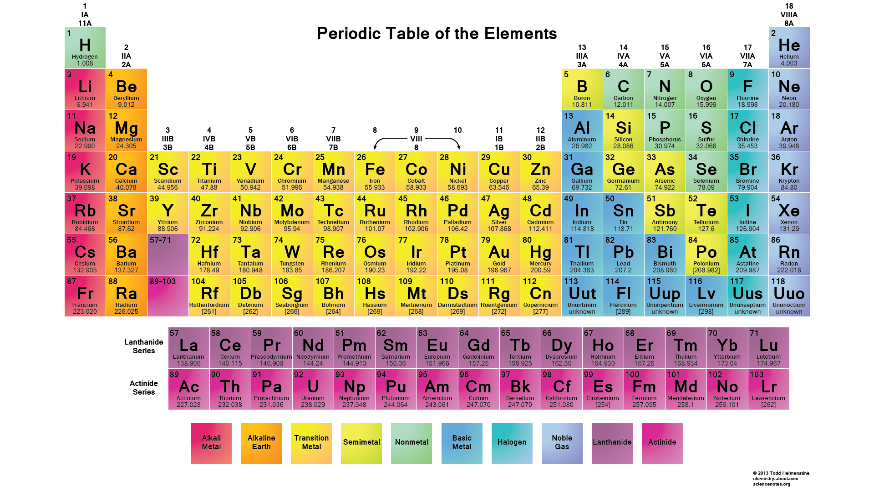
Locate the different families of main group elements on the periodic table and know their characteristic properties.
Distinguish between metals metalloids and non-metals. Know the properties of each.
Trends
What is the trend for shielding effect down a group? across a period? Explain.
What is the trend for effective nuclear charge down a group? across a period. Explain
What is the trend for atomic radius down a group? across a period? Explain in terms of shielding effect and effective nuclear charge.
What is the trend in reactivity of the Alkali Metals? Explain in terms of shielding effect.
What is the trend in reactivity of the Alkaline Metals?
What is the trend in reactivity of the Halogens?
What happens to the size of an atom if it gains or loses an electron?
Today's modern periodic table was arranged by ______________ and is in order of increasing_______________ .
Know the three main categories of the periodic table, where they are located and the properties of each category.
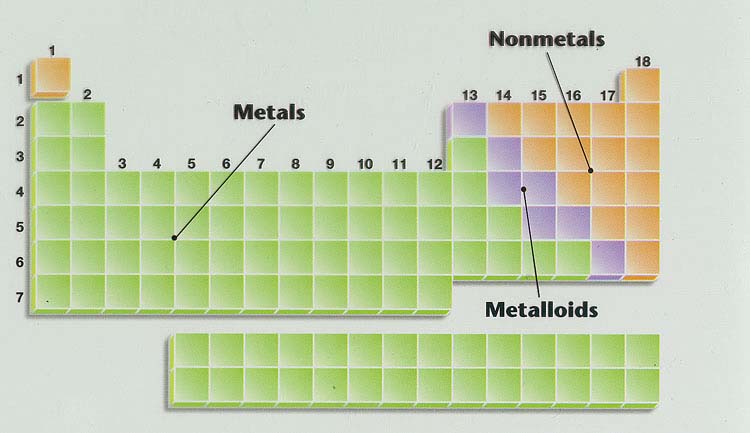
Know the groups of the periodic table, their location and their properties.
ELEMENT PROJECTS DUE 10/22-Worth a Test Grade! Get Started!
Instructions are below in the word document. Grading is on back though it may vary slightly. You will need to complete this project on your own time at home. Don't miss the opportunity to improve your grade!

|
ELEMENT PROJECT Grading Rubric Explanantion.doc Size : 26 Kb Type : doc |
Links for Periodic Table Webquest
Lab Title: Alkali Metals Reactivity Lab Make-Up
(If you missed the Alkali Metals Demonstrations Done in Class this Make Up Lab is for you.) Write the questions in your lab book then answer them.
Draw Bohr Models for Lithium Sodium and Potassium
What is the same about the 3 Bohr Models?
What is different?
Define Valence electrons
Define Energy Levels
Watch the video pausing it between metals to record your observations in your lab book.
After watching write a periodic law for reactivity of the alkali metals group.
Given the Bohr models, why is potassium more reactive than sodium?